Parchisi is a race to move all your pawns around a shared track and into your goal. Roll two dice, choose your moves, capture exposed rivals and reach the centre before everyone else.
1. Read the board
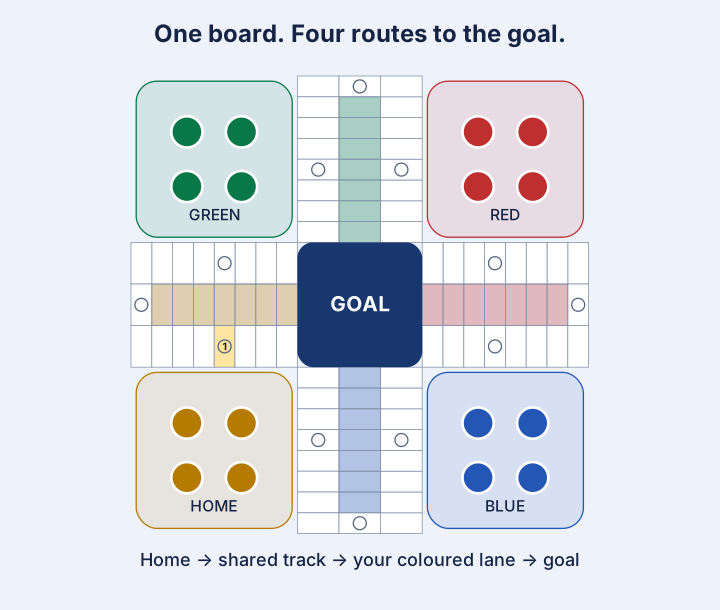
Each player has four pawns of one colour, initially in their corner, called home. Choose who starts and agree the turn order. The four-colour board accommodates up to four players.
Pawns enter at their starting square, follow the shared 68-square track counterclockwise, then turn into their own coloured goal lane. The goal is in the centre. Home and goal are different: captured pawns return home; finished pawns stay in the goal.
2. Enter with a five
A five on either die, or two dice totalling five, can bring a pawn onto its starting square. Entering spends that value.
Roll 5 and 2: enter with the five, then use the two for a legal move. Roll 2 and 3: spending their total to enter uses both dice.
Before playing, check whether your edition makes entry compulsory and how an occupied starting square affects it.
3. Use each die separately
Move different pawns with the two dice, or move the same pawn twice. Every intermediate landing and route must be legal. You cannot split one die between pawns or jump an obstacle by treating two dice as one long move.

Check both orders before skipping an unusable value. A blocked pawn may still leave another pawn a legal move.
4. Capture and stay safe
Land exactly on an unprotected rival to send it home. Passing over it does not capture it. A rival four squares ahead needs a legal four-square move, not a five.
A capture awards a 20-square bonus, taken as one legal move by one pawn. You cannot divide it; if no pawn can use the whole bonus, it is lost.
Safe squares normally prevent captures. Check your edition’s exceptions for starting-square entry and whether different colours may share a safe square.
5. Respect barriers
Two same-colour pawns on one square form a barrier, also called a blockade. Ordinary pawns cannot land on or pass it, including pawns of the same colour.
If a barrier is two squares ahead, a four cannot leap over it. Move another pawn or wait for the route to open. Some editions force barriers to break on doubles; agree that rule before starting.
6. Doubles earn another roll
Doubles means matching dice. Resolve your moves, then roll again. A third consecutive double can end your turn and return a pawn home.
Which pawn returns, and whether goal-lane pawns are protected, varies by edition. Some American Parcheesi rules also award bottom-face dice moves; do not assume that bonus applies to every version.
7. Finish by the exact count
After completing its track route, a pawn enters its coloured goal lane. It needs the exact remaining count to finish; overshooting is illegal.
Three squares from the goal with 2 and 4: you may move two and leave the pawn one short. Use the four elsewhere if possible; it cannot become a three.
Finishing a pawn awards a 10-square bonus for another legal move. The first player with all four pawns in the goal wins.
Your first game
Get several pawns moving, compare both dice orders and check the landing square before committing. For the game’s added powers, read the Remix rulebook: its Classic mode includes the new mechanics.
Sources
Rules checked 19 November 2026: BlackLight’s Parchisi rules, Northwestern’s die-movement examples, Tabletopia’s Parcheesi reference, and Gameberry’s mode differences and barrier rules. Illustrations and examples are original.